
Halal Awareness
The course aims to provide delegates with an overview of …
What you'll learn
Appreciate the size and nature of the global Halal markets.
Understand the principles of definitions of Halal, Haram and other relevant terms.
Become familiar with the contents and requirements of Halal standards.
Know the steps required to ensure their product is Halal.
Know what is required to ensure their processes are Halal compliant.
Become familiar with Halal auditing requirements.
Learn from the successes and mistakes of other companies.
Learn about the unique offering through the SGS partnership with HAB and what this entails

Automotive QMS IATF 16949:2016
Module 1 – Introduction to IATF 16949:2016 – 1 day …
What you'll learn
Gain an in-depth knowledge of the IATF 16949:2016 standard, including its scope, structure, and key requirements.
Develop the ability to conduct effective internal audits based on the requirements of IATF 16949:2016, covering clauses 4 through 10.
Learn how to apply essential core tools such as FMEA (Failure Modes and Effects Analysis), MSA (Measurement Systems Analysis), and SPC (Statistical Process Control).
Understand and interpret customer-specific requirements within the automotive sector to ensure compliance and quality management excellence.
ISO 50001 Energy Management Systems
Learn about the requirements of ISO 50001:2018 so that you …
What you'll learn
Follow a systematic approach to establish processes that will improve energy-related performance and energy efficiency
Incorporate the Plan-Do-Check-Act (PDCA) model and risk-based thinking into the management system processes so that you can address risks and make the most of any opportunities.
Create a culture where employees are encouraged to take an active role in saving energy and improving energy use and consumption

ISO 45001
Occupational Health and Safety legislation and how legal compliance forms …
What you'll learn
Explain the purpose of an OHS management system and the business and societal benefits of improving OHS performance.
Explain the role of an auditor to plan, conduct, report and follow up an OHS management system audit in accordance with ISO 19011 and ISO 17021-1 where appropriate.
Plan, conduct, report and follow up an audit of an OHS management system to establish conformity (or otherwise) with ISO 45001:2018 and in accordance with ISO 19011 (and ISO/IEC 17021-1 where appropriate).
ISO 14001
This course consists of three separate eLearning modules: ISO 14001:2015 …
What you'll learn
Follow a systematic approach to establish processes that will improve your organisation’s environmental performance
Incorporate the Plan-Do-Check-Act (PDCA) model and risk-based thinking into the management system processes so that you can address risks and make the most of any opportunities
Create a culture where employees are encouraged to take an active role in protecting the environment by contributing to sustainable practices that reduce the organisation’s environmental impacts and increases its operating efficiency
Successfully plan and implement a management system based on an ISO standard
Plan an internal audit of an environmental management system against ISO 14001:2015
Ensure changes to processes and procedures are communicated and everyone is trained so they can support and contribute to the management system objective
Complete an objective evaluation of your organisation’s current performance, to ensure processes are in place and operating as intended
Plan and prepare activities in readiness for the certification audit
Verify that the organisation is compliant with its own policies, procedures and associated documents by using the auditing principles and process
Report on the management systems effectiveness by gathering objective evidence and evaluating the extent to which environmental management system is being managed, controlled and continually improved
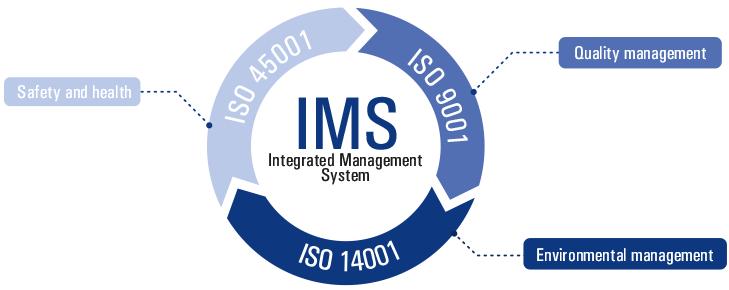
Integrated Management System
Instead of applying different standards in separate components, organizations may …
What you'll learn
Upon completion of this Course, you will be able to:
Have an overview of Integrated Management Systems (IMS) by:
Interpreting a system and an integrated management system.
Interpreting the integration of management systems.
Having an overview of PAS 99.
Interpret and apply the implementation requirements of ISO 9001:2015 by:
Having an overview of quality management systems.
Interpreting and applying the implementation requirements of ISO 9001:2015
Interpret and apply the implementation requirements of ISO 14001:2015 Environmental Management by:
Having an overview of environmental management systems.
Interpreting and applying the implementation requirements of ISO 4001:2015,
Interpret and apply the implementation requirements of OHS 45001:2018 Occupational Health and Safety Management by:
Having an overview of OHSAS 45001:2018.
Interpreting and applying the implementation requirements of OHS 45001:2018
Integrate the requirements of ISO standards
Basic Quality Concept
Learn about the requirements of ISO 9001:2015 and develop the …
What you'll learn
Follow a systematic approach to establish processes that will improve quality and give customers confidence in the products and services you provide
Incorporate the Plan-Do-Check-Act (PDCA) model and risk-based thinking into the management system processes so that you can address risks and make the most of any opportunities
Create a culture where employees are encouraged to take an active role in consistently providing products and services that meet customer, statutory and regulatory requirements
Use the quality management principles to improve customer satisfaction and raise quality awareness
Plan an internal audit of a quality management system against ISO 9001:2015 in accordance with ISO 19011:2018 and ISO/IEC 17021-1 as applicable
Verify that the organisation is compliant with its own policies, procedures and associated documents by using the auditing principles and process
Report on the management systems effectiveness by gathering objective evidence and evaluating the extent to which the quality management system is being managed and continually improved
- 1
- 2